
Samsung Galaxy Z TriFold
Samsung has stepped into a territory that no mainstream smartphone company has dared to enter: the world of multi-folding phones. With the launch of the Samsung Galaxy Z TriFold, Samsung once again pushes the boundaries of what a mobile device can be. After more than a decade of experimenting with folding screens, hinge designs, flexible displays and portable productivity, the company believes it has finally created something that feels like the next chapter of smartphones — a device that unfolds not once, but twice, stretching into a 10-inch display that sits somewhere between a tablet and an ultrathin laptop.
But as impressive as this engineering achievement looks, the TriFold also opens up a set of questions: Is this the future of mobile technology or simply an extravagant demonstration of what’s possible? Does the world need a phone that becomes a tablet through two folds, or is Samsung trying too hard to out-innovate competitors? And more importantly — will everyday consumers actually benefit from such a complicated form factor?
This article explores the device from all angles — the good, the bad, the impressive and the questionable — to give a balanced view of what Samsung’s newest experiment truly represents.
A Device Born From a Decade of Ambition
Samsung’s chief executive TM Roh described the TriFold as a response to one of the smartphone industry’s longest-standing challenges: how to give people a spacious, immersive screen without taking away the portability of a phone. Over the years, Samsung has worked through countless attempts — curved screens, phablets, first-generation foldables, and now, a device that closes inward twice.
There is no denying Samsung’s courage. The company has repeatedly risked being mocked, doubted or criticized for overreaching. Yet today, foldables — once considered gimmicks — have become legitimate devices used around the world. That same ambition is now driving the TriFold, which attempts to fuse phone, tablet and workstation into a single machine.
But ambition is not the same as practicality. This is where the TriFold’s story becomes complex.
Design: Slim, Sleek and Almost Unbelievable — but Also More Fragile Than a Traditional Phone
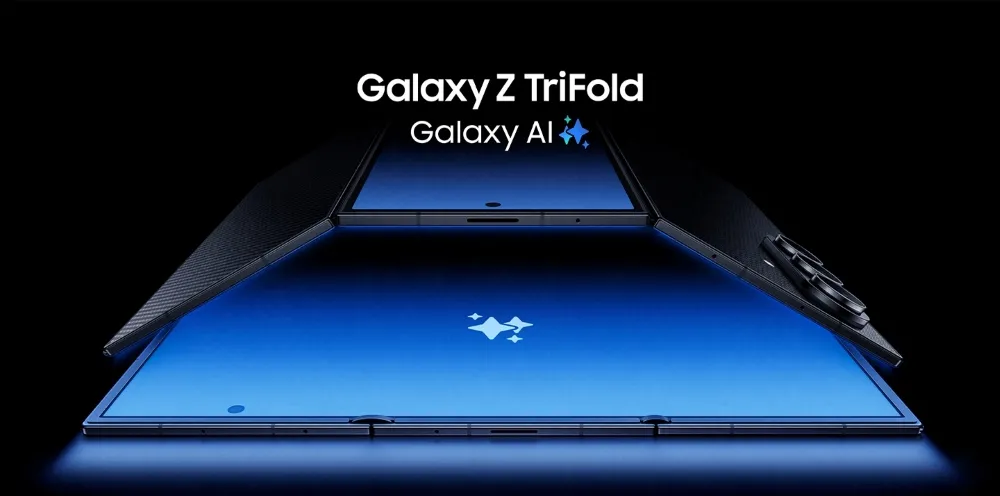
The engineering behind the TriFold is genuinely impressive. When folded, the device is surprisingly slim for a triple-panel phone. Samsung claims a 3.9 mm thickness at its thinnest point when opened, and an overall profile that still slips into a normal pocket when closed. This is a remarkable achievement considering the number of components squeezed inside.
The Positives
- The Armor FlexHinge — actually two differently sized hinges — works together with a dual-rail structure to create a fluid folding motion.
- The hinge design allows the panels to close with a minimal gap, reducing bulk and improving portability.
- A reinforced display layer and an improved overcoat make the screen feel sturdier than older foldables.
- Titanium hinge housing and an advanced aluminum frame add toughness while keeping weight manageable.
These innovations don’t feel like minor upgrades — they feel like the kind of advances that took years to refine.
The Negatives
However, even after all this engineering magic, the TriFold is still a foldable at heart — and foldables have unavoidable weak points.
- More moving parts mean more chances for failure.
- The screen, though reinforced, is still softer than a typical glass display.
- Dust resistance is still a concern in any foldable mechanism.
- Three separate battery cells add complexity that may impact long-term reliability.
For a device expected to be extremely expensive, durability worries may hold some buyers back.
Performance: A Powerhouse on Paper, But Will Software Fully Keep Up?
Samsung equipped the TriFold with some of the strongest hardware currently available: a Snapdragon 8 Elite Mobile Platform, a gigantic 200 MP camera, and the largest battery the company has ever placed in a foldable — a 5,600 mAh three-cell system.
What’s Impressive
- The battery layout across three panels ensures balanced weight and power flow.
- 45W super-fast charging reduces downtime even for heavy users.
- The chipset is powerful enough to handle advanced AI tasks, editing tools, and heavy multitasking.
What Might Hold It Back
But raw power is not the issue. The challenge is software — apps and interfaces need to be optimized for a multi-folding display. While Samsung has added special multi-window options and tools, it remains unclear how many third-party apps will truly support such a unique layout.
If apps fail to adapt, users may find themselves with wasted screen space or awkward UI scaling.
A 10-Inch Screen Inside a Pocket — Great for Productivity, But Too Much for Casual Use?
When fully opened, the TriFold becomes a 10-inch display, which Samsung claims operates like three 6.5-inch phones stitched together.
Where the Large Screen Shines
- Multitasking feels more natural with up to three full portrait apps open at once.
- Documents, spreadsheets and creative tools finally have room to breathe.
- Professionals can switch between apps using a redesigned taskbar.
- Architects, designers, editors and students can use the screen like a mini-workspace.
- Samsung DeX can run standalone, making the device behave almost like a small PC.
- Extended mode allows connection to an external monitor for true dual-screen setups.
This could be game-changing for users who constantly travel but need laptop-like capability in their pocket.
But Not Everyone Wants a Giant Screen
The flip side is that many consumers simply don’t need this level of multitasking.
If someone primarily uses a phone for:
- messaging
- social media
- streaming
- casual browsing
…the triple-fold form factor might feel unnecessary, or even inconvenient.
A phone is supposed to be quick and simple — and the TriFold is anything but simple.
Galaxy AI: Useful, Impressive, But Still Finding Its Place
Samsung’s AI features — from Photo Assist to Generative Edit to Browsing Assist — are all present here, enhanced by the larger display.
Why It Works Well
- Side-by-side comparison of photo edits is smoother on a wide canvas.
- Sketch-to-image tools feel more natural with more drawing space.
- Gemini Live becomes more powerful when the phone can understand images, voice and on-screen content simultaneously.
- Real-time design suggestions and product comparisons feel practical for creative work.
Why It Still Feels Unfinished
However, some AI features may feel excessive. Not every user needs real-time shopping analysis, room design recommendations or advanced photo manipulation. And while AI is undoubtedly useful, some people may question whether the TriFold is built for them or built for showcasing AI experiments.
Entertainment: A Mini Cinema That Fits in a Pocket — But With Familiar Foldable Limitations
One of the TriFold’s strongest benefits is entertainment. A 10-inch cinematic screen with Dynamic AMOLED 2X technology and a 120Hz refresh rate makes videos, movies and even YouTube comments shine.
The Highlights
- Colors remain bright and vivid, even under sunlight thanks to up to 2600 nits brightness.
- A minimized crease keeps content looking cleaner.
- Smooth scrolling and animation enhance the tablet-like experience.
The Downsides
But again, foldable realities hit hard:
- The inner display is still softer than glass.
- A large unfolded device requires two hands.
- Bezels, though thin, are still more noticeable compared to standard tablets.
- Speakers, though loud, cannot match the resonance of larger tablets or laptops.
Entertainment is one of the TriFold’s biggest strengths — but it’s not flawless.
Price and Availability: A Premium Device Meant for Premium Buyers
The Galaxy Z TriFold will debut first in Korea on December 12, 2025, followed by major global markets. Samsung is giving buyers some incentives, including:
- A 6-month Google AI Pro trial
- 2 TB of cloud storage
- A one-time 50% discount on display repair
These benefits suggest Samsung knows repairs will be expensive — and that the early adopter audience is likely concerned about long-term durability.
There is no confirmed price yet, but industry expectations lean toward the ultra-premium segment, far above standard flagships.
Is the Galaxy Z TriFold the Future of Smartphones? A Balanced Verdict
The Case For the TriFold
- It’s one of the most innovative devices created in the last decade.
- It sets a new standard for what mobile productivity can look like.
- It proves Samsung remains the leader in foldable engineering.
- It combines phone, tablet and PC experiences better than any previous hybrid device.
The Case Against the TriFold
- It is likely too expensive for mainstream users.
- Its durability is still a question mark.
- The form factor may be overkill for people who don’t need heavy multitasking.
- Software optimization across all apps may not be perfect.
- The device might feel like innovation for innovation’s sake.
The Larger Picture
The Galaxy Z TriFold is more than a phone — it is a statement. It shows where the industry could go, not necessarily where it will go for everyone. Samsung’s engineering is remarkable, but the real question is whether everyday users will embrace such a complex device.
This is a machine for enthusiasts, creators, professionals, travelers and tech lovers who want the best — and are willing to pay for it. It is not the average user’s next smartphone, but it could inspire the designs of future ones.
For now, the TriFold stands as both a triumph and a risk:
A bold step forward wrapped in practical challenges. A breakthrough mixed with compromises. A glimpse of the future — but not yet the universal future.
Samsung Galaxy Z TriFold
| Feature | Specifications |
|---|---|
| Main Screen | 10.0″ QXGA+ Dynamic AMOLED 2X 2160 × 1584 (269 PPI) 1600 nits peak brightness 120Hz adaptive refresh rate (1-120Hz) |
| Cover Screen | 6.5″ FHD+ Dynamic AMOLED 2X 2520 × 1080 (422 PPI) 2600 nits peak brightness 120Hz adaptive refresh rate (1-120Hz) |
| Dimensions (Folded) | 159.2 × 75.0 × 12.9 mm |
| Dimensions (Unfolded) | 159.2 × 214.1 × 3.9-4.2 mm |
| Weight | 309 g |
| Materials | Corning® Gorilla® Glass Ceramic 2 (Front) Ceramic-Glass Fiber Reinforced Polymer (Back) Titanium Hinge + Armor Aluminum Frame |
| Colors | Crafted Black |
| Water Resistance | IP48 Rating |
| Lens | Specifications |
|---|---|
| 200MP Wide | Quad Pixel AF, OIS, F1.7 0.6 μm pixel size, 85° FOV 2× Optical Quality Zoom |
| 12MP Ultra-Wide | Dual Pixel AF, F2.2 1.4 μm pixel size, 120° FOV |
| 10MP Telephoto | PDAF, OIS, F2.4 1.0 μm pixel size, 36° FOV 3× Optical Zoom, 30× Space Zoom |
| Location | Specifications |
|---|---|
| Cover Screen | 10MP, F2.2, 1.12 μm, 85° FOV |
| Main Screen | 10MP, F2.2, 1.12 μm, 100° FOV |
| Component | Specifications |
|---|---|
| Processor | Snapdragon® 8 Elite Mobile Platform for Galaxy (3nm) |
| Memory | 16GB RAM |
| Storage | 512GB / 1TB UFS 4.0 No microSD support |
| OS | Android 16 with One UI 8 |
| Security | Samsung Knox with Knox Vault Side-mounted fingerprint sensor |
| Feature | Specifications |
|---|---|
| Battery | 5,600 mAh (typical) 5,437 mAh (rated) |
| Wired Charging | Super-Fast Charging 2.0 (45W) 50% in ~30 minutes |
| Wireless Charging | Fast Wireless Charging 2.0 (15W) Wireless PowerShare (reverse charging) |
| Type | Specifications |
|---|---|
| Network | 5G, LTE |
| Wireless | Wi-Fi 7, Bluetooth® 5.4 |
| SIM | Dual Nano SIM + Multi eSIM |
| Feature | Details |
|---|---|
| Sensors | Accelerometer, Barometer, Gyro, Geomagnetic, Hall, Proximity, Light |
| Security | Capacitive fingerprint sensor (side), Samsung Knox Vault |
| Audio | Stereo speakers (by AKG) |
| Haptics | Enhanced vibration motor |
| Software Features | Flex Mode, Multi-Active Window, S Pen support* |
Note: Some specifications may vary by region or carrier. Display sizes are measured diagonally as full rectangles; actual viewable area is slightly less due to rounded corners.
🌟 Key Highlights
- World’s first triple-folding display with 10-inch main screen
- 2600 nits peak brightness on cover screen (industry-leading)
- 200MP professional-grade camera with 2× optical quality zoom
- Titanium hinge for enhanced durability
- 5600mAh battery with 45W super-fast charging
- IP48 water resistance for added protection
- Snapdragon 8 Elite 3nm processor for ultimate performance
- 16GB RAM + up to 1TB storage for power users
More From Us – https://gateuserinternational.com/kling/
